Meat toppers supplied as an ingredient, not as a finished snack. You set the cut, the grading and the pack — we hold the specification batch to batch, so the topper behaves the same way in your line every time.
A retail treat has one job: look good in a bag and get eaten. A topper has to survive your process — it is metered, blended, sometimes wetted, then packed inside somebody else's product. That changes what "good" means:

Three questions come up in every topper brief, and the same three decide whether it works in your product. None of them has a catalogue answer — each depends on your line, your mix ratio and your pack.
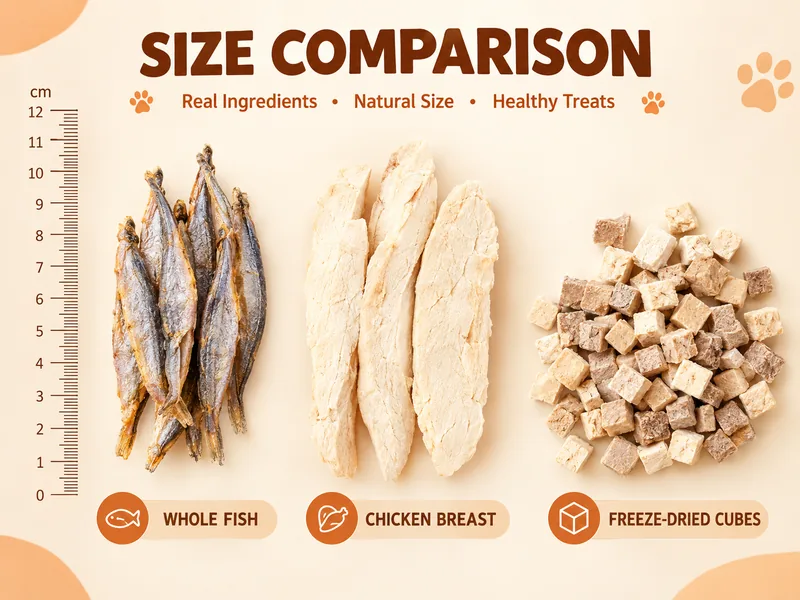
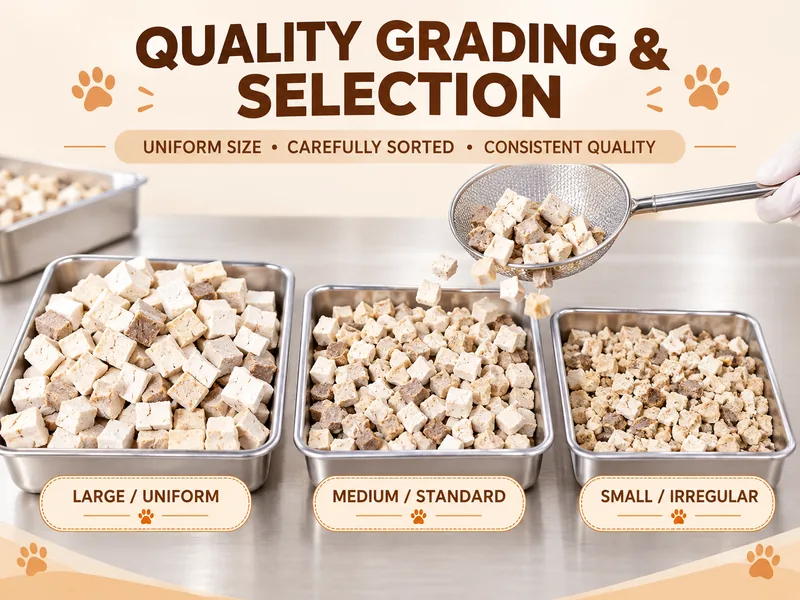
Whole slice, cube, dice or crumble. What matters is a narrow distribution at the cut you choose, so the topper meters consistently and does not separate in the pack.
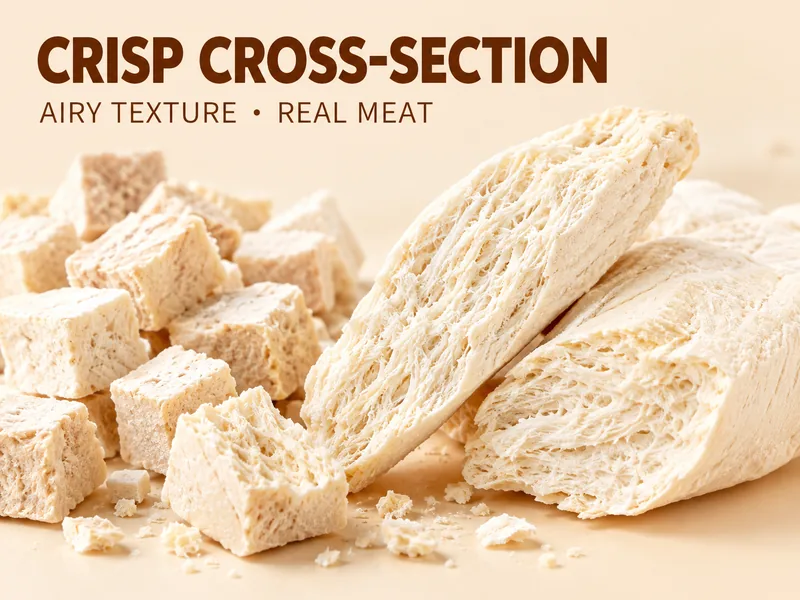
Freeze-dried meat rehydrates quickly and absorbs water from whatever it is mixed with. How fast depends on piece thickness and on the temperature of the food — which is why we test it with your usage rather than quote a number.
Two components separate when their particle size and bulk density differ. A topper that looks right in a bowl can sink to the bottom of a kibble bag after a week of transport.


Indicative ranges for the format. Your grading, composition and pack are confirmed at sampling and frozen in writing before production.
| Protein sources | Chicken breast · Duck · Beef · Salmon · Whitefish · Lamb · Rabbit · Quail egg yolk, and other proteins on request |
|---|---|
| Ingredients | Single ingredient, or blended to your formula |
| Moisture content | Approximately 3–6% |
| Protein content | Typically 70–80% on a dry basis (varies by protein source) |
| Topper formats | Whole slice · Cube · Dice · Crumbled · Powder |
| Grading | Agreed against your sieve or screen specification; mixed grading available |
| Packaging | Stand-up pouch · Flat pouch · Gusset bag · Tub, with or without window. Oxygen absorber and resealable zip available |
| Net weight options | From 20 g retail packs to 5 kg bulk — fully negotiable |
| Shelf life | 18–24 months, unopened, at ambient temperature |
| Storage | Cool, dry, away from direct sunlight. No refrigeration required. |
| Target species | Cats and dogs |
On particle size: we do not publish a fixed mesh range, because the right cut depends on your sieve, your mix ratio and your pack — a single number would be wrong for most buyers. Tell us the screen or the target piece size you work to, and grading is agreed and recorded in the specification sheet attached to your quotation. The ranges above describe the format in general and are not a certificate of composition.
We can only answer that with three pieces of information from you. With them, the sample we send is the sample you would run — not a best-case version of it.
The sieve size, screen aperture or target piece dimension your line is set up for. If you do not have one yet, send the pack format and we will propose two or three cuts to test.
How much topper goes into how much food, by weight. Inclusion rate drives both the visual result and the separation risk, and it is the number most often left out of a brief.
Kibble bag, can, pouch or tub; vacuum, nitrogen-flushed or plain. Whether the topper is added dry or after the food is wetted changes what we need to test.
At sampling we run a mix test against the information above — including a settle test, so you see whether the topper stays distributed after transport rather than only on day one.
7–10 days from specification agreement, plus courier transit. Sampling policy — fee, and whether it is credited against the first order — is stated upfront in your quotation.
25–35 days from deposit and artwork approval. Three QC checkpoints per batch, with photo updates during the run.
FOB or CIF to your port. The product is ambient-stable, so sea and air freight are both viable — we will quote both.
We reply within 24 hours on business days — usually with MOQ, indicative pricing and what a topper trial would involve.